Interior design trends today are no longer defined only by colors and shapes. Technological developments, the interplay between space and visuals, and everyday usability play an increasingly important role.
In this article, we want to illustrate how the range of interior doors is changing in 2026, which directions are worth following, and which questions tend to lead to common mistakes when choosing a door.
Starting point – unity between walls, floors and doors
In 2026, the foundation of a good choice is still the same: walls, floors and doors should form a unified whole. These three elements define the interior. That’s why you can no longer choose a door without rethinking your overall style.
Contrast or harmony?
In modern interiors, two design approaches continue to work particularly well:
- When everything is about harmony: the tones of the wall and the door are almost identical, and the floor is part of the subtle transition.
- When strong contrasts shape the space: in this type of interior, the door becomes the visual focal point. For example, choosing a deep-toned door leaf for a light wall, or a boldly grained wood door in a clean, minimalist room.
In the 2026 door trends, accessories and glazed surfaces gain increasing importance. Erkado, for example, is introducing innovations such as black hardware for rebated doors, and a new moisture-resistant frame construction, the AQUA Stop frame with a waterproof MDF structure. From a design perspective, one of the key innovations at the beginning of the year is that the JASMIN and VERBENA models are getting new painted color options.
An interior door in 2026 is modern if it belongs to the space as a whole. Whether the look is harmonious or contrasting is primarily determined by light conditions and the chosen floor and wall finishes. Which brings us logically to the next question: which wall–door combinations are reliably successful?

Foolproof pairings – interior door colors you can’t go wrong with
White door + light wall
This timeless, minimalist combination is coming back into focus in 2026, mainly because natural light and brightness are baseline expectations in modern spaces. It’s no coincidence that Cloud Dancer became the color of the year for 2026.We believe white doors will be particularly popular in:
- Scandinavian interiors,
- clean, contemporary family homes
- premium, newly built apartments
New from Erkado! Verbena and Jasmin models in titanium UV-cured white and cashmere shades. This white offers a far more even surface and outstanding durability.
So a white door is a safe choice when you want to preserve the clarity of the space. The next trends, however, bring more character into the interior.
Wood-grain door + warm flooring
A new renaissance of natural patterns is happening right before our eyes. Oak, walnut and ash-grain modern interior doors were highly sought after in 2025, and this trend will most likely remain unchanged in 2026. This combination is especially good when:
- the floor has warm tones (laminate, SPC, vinyl)
- the wall color is off-white, beige or cappuccino
- you want to emphasize the warmth of the space
Another novelty for 2026 is the Erkado Magnolia model in a 2112 mm standard height. This taller door allows for even more elegant, striking proportions in modern homes.
Wood-effect finishes will remain popular in 2026, because their natural feel brings warmth into minimalist interiors. Many homeowners, however, are looking for even more characterful interior design solutions.
Dark door + minimal interior
Black, anthracite and deep graphite will be among the most popular elements of door color trends, and will become dominant components in modern homes.
These MDF interior door colors can have a particularly strong impact in large spaces, homes with plenty of natural light, industrial and loft-style interiors.
In our view, dark doors give a home a level of character and depth that everyone will remember. The next question, though, is whether it always makes sense to follow the current trend.
Trends – when to follow them and when to think differently?
In 2026, modern interior door trends focus primarily on materials, surfaces and details. The most important principle, however, is that you should always choose a door that fits your style and takes into account the characteristics of your home.
Patterned walls and textured surfaces
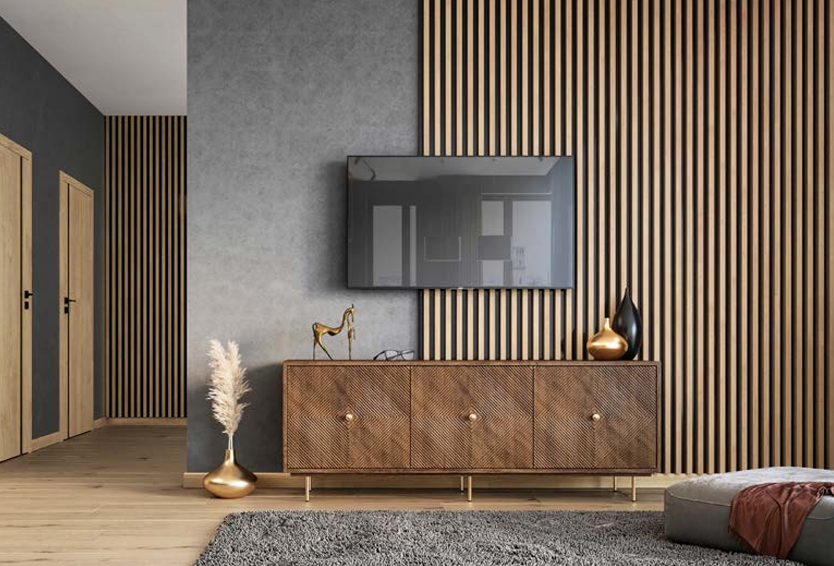
Textured walls (e.g. microcement, decorative paint, 3D panels) work best with clean, understated doors. If the wall is the main visual element, the door should be simple CPL or painted MDF.
If, however, you have a clear idea about the type and style of door, then you should adjust the color and style of the walls and floors to match it.

Handle and hardware colors
By 2026, poorly matched elements are no longer considered acceptable in a renovation or new build. Price is no longer an excuse: you can now find virtually any color, style and form in every price segment. The color of the handle should match the frame, the hinges, the visible hardware and the metal elements in the room (e.g. lighting, taps).
Because interior design materials are now easy to access and the range is wide, and because sales staff in stores are generally well-trained professionals, you can get help matching colors from many different sources.
New Erkado technologies that may shape the future
- AQUA Stop moisture-resistant frame (waterproof MDF + WPC cladding) → ideal for bathrooms and wellness areas
- 110 cm-wide sliding doors → new planning freedom in open-space interiors
- UV-cured painted surfaces → more uniform and durable than traditional lacquer finishes
Following interior design trends is a good thing—but only if the ideas, once put together, fit the space as a whole. Now let’s look at which mistakes to avoid.
Common mistakes that ruin a modern overall look
An interior can quickly fall apart if it bombards the eye with too many impulses. Wall colors, furniture, décor and lighting all contain countless possibilities for elevating a space. For this very reason, modern interior doors are not automatically the right solution for every home. A multitude of colors, shapes and patterns can easily distort the overall impression.
From our perspective, the following mistakes were typical in 2025—mistakes you can avoid in 2026.
Too many textures in one space
A simple example: wood grain + stone effect + concrete + patterned wall + dark door all in one room. In this case, the interior loses its “identity”. The essence of modern spaces is to have two dominant textures, not five.
Poor contrast choices
A dark door on a dark wall will not catch the eye; it will simply give the home a gloomy, oppressive feel. The opposite is also true: a light door in an overly bright space can create a clinical, “hospital-like” effect. In every case, it’s the light conditions that decide which option works well.
Handle and hardware pairing
In a perfectly designed interior, a handle is like a piece of jewelry: small, but highly defining. A gold handle on a black door? It can work—but then the entire interior concept needs to be aligned with it. What does not look good in any interior style is shiny chrome on warm wood grain.
Of course, there are many more possible mistakes; here we focused specifically on MDF interior doors. Finally, let’s see how all this comes together in the decision-making process.
So what makes an interior door modern in 2026?
Choosing the right door today is just as much about harmony, light conditions and conscious material pairing as it is about technical parameters. The examples in this article clearly show that successful design always starts with aligning the door’s color, surface and construction with the walls, the floor and the overall style of the space. Foolproof combinations—such as a white door with light walls, a wood-grain model with warm flooring, or a dark door in a minimalist interior—are used worldwide for a reason. These are timeless, well-functioning solutions that will remain relevant in 2026.
Following the latest trends can be tempting, but it’s important to see that not every trend belongs in real homes. A unique patterned wall or bold handle can look impressive in a designer project, but in a family living space it only truly works if it doesn’t become overdecorated or visually disturbing. Recent experience shows that modern doors are now more about understated elegance, subtle textures and natural materials than about loud visual effects.
The mistakes described in this article highlight how easy it is to unintentionally break the coherence of an otherwise well-planned interior. If too many textures collide, if contrasts are not thought through, or if the style of the handle and hardware doesn’t match the door, the entire space can feel chaotic. In most cases, this can be avoided with conscious color choices, simpler material combinations and quality detailing.
If you follow these principles when choosing a new interior door, it will become one of the most beautiful and important elements of your home for many years—both in terms of style and everyday usability.